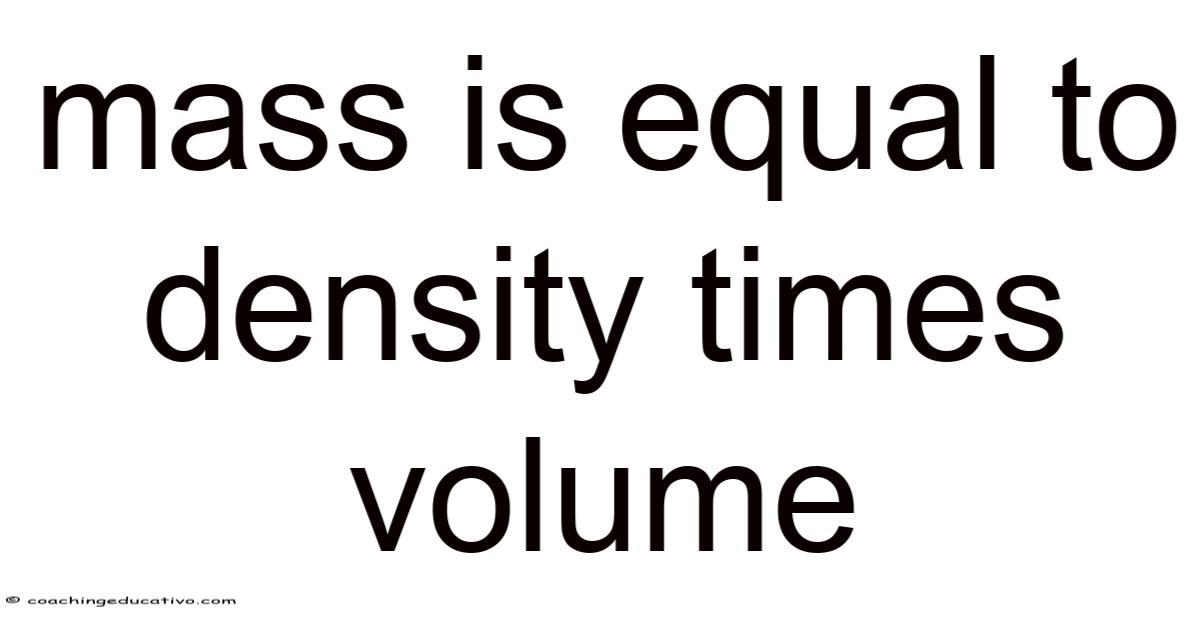
Imagine you're holding a small pebble in one hand and a basketball in the other. That's because weight isn't just about size; it's about how much "stuff" is packed into that space. The basketball is obviously much larger, but which one feels heavier? This "stuff," technically speaking, is mass, and the amount of mass within a given space defines its density. The answer isn't immediately obvious. This interplay between mass, density, and volume is fundamental to understanding the physical world, and it's beautifully summarized by the simple equation: mass is equal to density times volume Took long enough..
Understanding the relationship between mass, density, and volume isn't just a theoretical exercise; it's a practical tool used across countless disciplines. From predicting whether a ship will float to determining the composition of distant stars, the principle that mass equals density times volume provides essential insights. But what exactly do these terms mean, and how do they relate to each other? Let's look at the core of this equation, explore its applications, and uncover the fascinating ways it shapes our understanding of the universe And that's really what it comes down to..
Not obvious, but once you see it — you'll see it everywhere.
Main Subheading
The formula mass = density × volume, often written as m = ρV, represents a fundamental relationship in physics and material science. It connects three intrinsic properties of matter: mass, which is the measure of the amount of matter in an object; density, which is the measure of how tightly that matter is packed together; and volume, which is the amount of space that the object occupies. This equation provides a way to calculate any one of these properties if the other two are known, making it an incredibly versatile tool for scientists, engineers, and anyone interested in the physical world.
Real talk — this step gets skipped all the time.
At its core, the equation highlights that the mass of an object is directly proportional to both its density and its volume. What this tells us is if you increase the density of a substance while keeping its volume constant, the mass will increase proportionally. Also, similarly, if you increase the volume of an object made of a uniform material, its mass will also increase proportionally. Conversely, if you know the mass and volume of an object, you can determine its density, providing insights into its composition and structure.
Comprehensive Overview
Let's break down each component of the equation m = ρV to fully understand its meaning and implications.
Mass (m): Mass is a fundamental property of matter that measures its resistance to acceleration. In simpler terms, it's a measure of how much "stuff" is in an object. The standard unit of mass in the International System of Units (SI) is the kilogram (kg). Mass is an intrinsic property, meaning it doesn't change based on location or gravitational forces. This is different from weight, which is the force exerted on an object due to gravity. An object's mass remains constant whether it's on Earth, the Moon, or in deep space, while its weight will vary depending on the gravitational pull Practical, not theoretical..
Density (ρ): Density is a measure of how much mass is contained within a given volume. It essentially describes how tightly packed the matter is in a substance. Density is typically expressed in units of kilograms per cubic meter (kg/m³) in the SI system, or grams per cubic centimeter (g/cm³) in the CGS system. A higher density indicates that more mass is packed into the same amount of space. To give you an idea, lead has a much higher density than wood because the atoms in lead are more tightly packed. Density is an intensive property, meaning it doesn't depend on the amount of substance present. A small piece of gold has the same density as a large gold bar.
Volume (V): Volume is the amount of three-dimensional space that an object occupies. The standard unit of volume in the SI system is the cubic meter (m³), although liters (L) and milliliters (mL) are also commonly used, especially for liquids. The volume of a regular-shaped object, like a cube or a sphere, can be calculated using geometric formulas. For irregularly shaped objects, volume can be determined by displacement methods, such as submerging the object in water and measuring the volume of water displaced.
The formula m = ρV is derived from the definition of density itself. Even so, density is defined as mass per unit volume, which can be expressed as ρ = m/V. On the flip side, by rearranging this equation, we get m = ρV. This simple algebraic manipulation allows us to calculate mass if we know the density and volume, or to calculate density if we know the mass and volume No workaround needed..
Historically, the understanding of mass, density, and volume evolved over centuries. Ancient Greek philosophers like Archimedes made significant contributions to understanding buoyancy and displacement, which are closely related to density. That said, it was the development of accurate measurement techniques and the formalization of physics principles by scientists like Isaac Newton that led to the precise definition and application of the m = ρV relationship Easy to understand, harder to ignore..
The significance of the m = ρV equation extends beyond simple calculations. Here's the thing — in fluid mechanics, density differences drive convection currents and influence buoyancy. It forms the basis for understanding material properties, fluid dynamics, and even astronomical phenomena. Here's one way to look at it: knowing the density of a material is crucial in engineering design, as it affects the structural integrity and performance of objects. In astronomy, the density of stars and planets provides clues about their composition, formation, and evolution Most people skip this — try not to..
The official docs gloss over this. That's a mistake.
Trends and Latest Developments
The relationship between mass, density, and volume continues to be a relevant area of research and application in modern science and technology. Several trends and developments highlight the ongoing importance of this fundamental concept.
Material Science: In material science, researchers are constantly exploring new materials with tailored densities to achieve specific properties. Take this: the development of lightweight yet strong materials for aerospace applications relies heavily on manipulating density. Composites, alloys, and advanced polymers are designed with specific densities to optimize performance, reduce weight, and enhance fuel efficiency. The ability to precisely control density at the nanoscale is also driving innovation in areas like nanotechnology and metamaterials.
Medical Imaging: Density plays a critical role in medical imaging techniques such as X-rays and CT scans. These technologies rely on the differential absorption of radiation by tissues of different densities to create images of the body's internal structures. Bone, being denser than soft tissue, absorbs more radiation and appears brighter on X-rays. By analyzing density variations, doctors can diagnose a wide range of conditions, from fractures to tumors. Advances in imaging technology are continually improving the resolution and accuracy of density measurements, leading to earlier and more precise diagnoses.
Geophysics: In geophysics, density variations within the Earth provide insights into its structure and composition. Seismic waves travel at different speeds through materials of different densities, allowing scientists to map the Earth's interior. By analyzing the travel times of seismic waves, geophysicists can determine the density of the crust, mantle, and core, and gain a better understanding of plate tectonics, volcanism, and other geological processes.
Oceanography: The density of seawater is a crucial factor influencing ocean currents and marine ecosystems. Density differences caused by variations in temperature and salinity drive thermohaline circulation, a global system of ocean currents that plays a vital role in regulating climate. Understanding the density structure of the ocean is essential for predicting ocean currents, tracking pollution, and managing marine resources But it adds up..
Astronomy: Astronomers use density to characterize celestial objects and understand their evolution. The density of a star, for example, is a key parameter in determining its life cycle and eventual fate. White dwarfs and neutron stars are incredibly dense objects formed from the remnants of collapsed stars. By measuring their densities, astronomers can test theories of stellar evolution and probe the fundamental properties of matter under extreme conditions.
A recent study published in the journal Nature Materials highlighted the development of a new class of lightweight metallic materials with exceptionally high strength-to-density ratios. Another study in the Journal of Geophysical Research used density data from satellite gravity measurements to improve our understanding of groundwater storage and depletion in arid regions. These materials, created using advanced manufacturing techniques, have the potential to revolutionize industries ranging from aerospace to automotive. These examples illustrate the ongoing relevance and importance of density measurements in addressing pressing scientific and societal challenges Small thing, real impact..
Tips and Expert Advice
Understanding and applying the m = ρV equation can be made easier with a few practical tips and insights. Here's some expert advice to help you master this fundamental concept:
Choose the Right Units: Consistency in units is crucial for accurate calculations. see to it that you're using compatible units for mass, density, and volume. If density is given in grams per cubic centimeter (g/cm³), mass should be in grams and volume in cubic centimeters. If you're working with SI units, density should be in kilograms per cubic meter (kg/m³), mass in kilograms, and volume in cubic meters. If necessary, convert units before performing calculations to avoid errors.
Understand the Context: Consider the context of the problem you're trying to solve. Different materials have different densities, so don't forget to know what you're working with. Look up the density of common materials in reference tables or online databases. For mixtures or composite materials, you may need to calculate the effective density based on the proportions of the different components.
Consider Temperature and Pressure: Density can be affected by temperature and pressure, especially for gases. When working with gases, make sure to account for these effects using the ideal gas law or other appropriate equations of state. For liquids and solids, the effect of temperature and pressure on density is usually smaller but may still be significant in some cases Simple, but easy to overlook..
Use Measurement Tools Carefully: When measuring mass and volume, use appropriate tools with the necessary precision. Electronic balances provide accurate mass measurements, while graduated cylinders, beakers, and volumetric flasks are used to measure volume. For irregularly shaped objects, use displacement methods to determine volume. Be mindful of measurement errors and uncertainties, and propagate them through your calculations to estimate the uncertainty in your final result Nothing fancy..
Apply the Equation in Real-World Scenarios: Practice applying the m = ρV equation in real-world scenarios to solidify your understanding. Here's one way to look at it: calculate the mass of water in a swimming pool given its dimensions and the density of water. Determine the density of a rock sample by measuring its mass and volume. Estimate the mass of air in a room using its dimensions and the density of air. By working through these types of problems, you'll develop a deeper intuition for the relationship between mass, density, and volume.
Example: Imagine you have a gold bar with a volume of 100 cm³. The density of gold is 19.3 g/cm³. To find the mass of the gold bar, you would use the formula m = ρV. Plugging in the values, you get m = 19.3 g/cm³ × 100 cm³ = 1930 g, or 1.93 kg. This simple calculation demonstrates how the m = ρV equation can be used to determine the mass of an object given its density and volume.
FAQ
Q: What is the difference between density and specific gravity? A: Density is the mass per unit volume of a substance, typically expressed in kg/m³ or g/cm³. Specific gravity, on the other hand, is the ratio of the density of a substance to the density of a reference substance, usually water at 4°C. Specific gravity is a dimensionless quantity, meaning it has no units Took long enough..
Q: How does temperature affect density? A: Generally, as temperature increases, density decreases. This is because the increased thermal energy causes the atoms or molecules in a substance to move faster and spread out, increasing the volume. On the flip side, there are exceptions, such as water between 0°C and 4°C, where density increases with increasing temperature Worth knowing..
Q: Can density be negative? A: In ordinary matter, density is always positive because mass and volume are always positive. On the flip side, in theoretical physics, there are concepts like "negative mass" that could lead to negative density, but these are highly speculative and have not been observed in the real world That's the whole idea..
Q: How is density used in everyday life? A: Density is used in many everyday applications, such as determining whether an object will float or sink in water, identifying different types of materials, and ensuring the quality of food products. Here's one way to look at it: the density of milk is used to check its fat content, and the density of gasoline is used to ensure its purity.
Q: What are some common densities I should know? A: Some common densities to remember are: Water (1 g/cm³ or 1000 kg/m³), Air (approximately 1.2 kg/m³ at sea level), Aluminum (2.7 g/cm³), Iron (7.9 g/cm³), Lead (11.3 g/cm³), and Gold (19.3 g/cm³) Easy to understand, harder to ignore..
Conclusion
In a nutshell, the equation mass = density × volume (m = ρV) is a cornerstone of physics and material science, providing a fundamental relationship between these three essential properties of matter. Here's the thing — understanding this equation allows us to calculate the mass, density, or volume of an object if the other two are known, offering valuable insights into its composition and behavior. From engineering design to medical imaging and astronomical observations, the m = ρV equation finds applications in diverse fields, underscoring its versatility and importance.
By mastering the concepts of mass, density, and volume, and practicing applying the m = ρV equation, you can gain a deeper appreciation for the physical world around you. On top of that, whether you're a student, a scientist, or simply curious about how things work, this equation provides a powerful tool for understanding and exploring the properties of matter. Dive deeper into related topics such as buoyancy, specific gravity, and material properties to further expand your knowledge. Share this article with others who might benefit from understanding this fundamental concept, and leave a comment below with your own insights and questions Worth knowing..
